Interest Rates
Bank of England raises rates to 4% as inflation risks grow
All rate-setters backed tighter policy as the Bank forecast inflation of 4.9% next year and warned that another increase could follow.

By Priya Nair, Finance & Tax Reporter ·
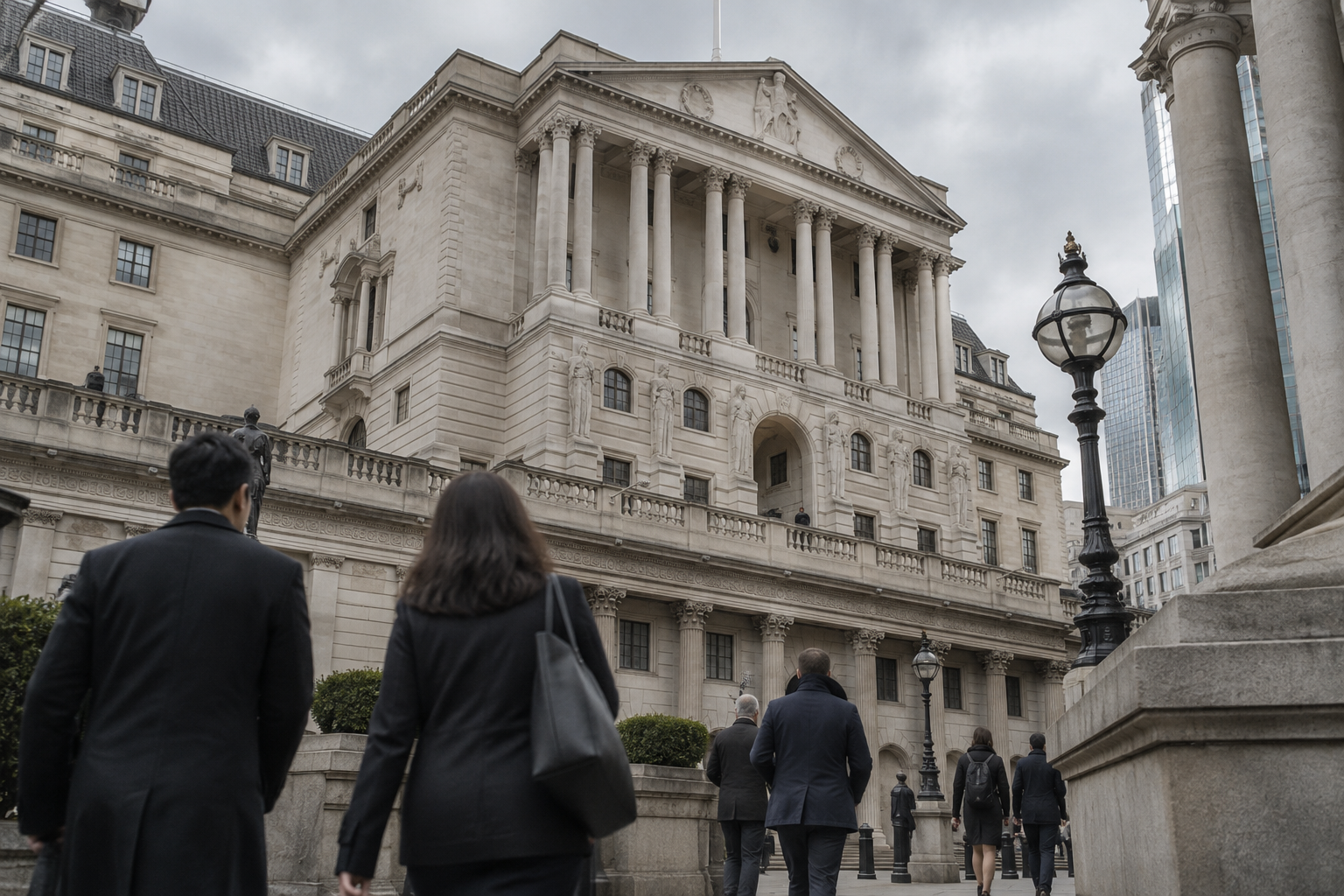
The Bank of England has raised UK interest rates to 4%, with every member of its Monetary Policy Committee backing tighter policy as it forecast inflation could reach 4.9% in the middle of next year.
The decision, reported by City AM, marks the first increase since mid-2023. Governor Andrew Bailey warned that a prolonged war between the US and Iran could require another rise, while the Bank projected a substantial increase in mortgage costs compared with its pre-war outlook.
What happened
Although all policymakers supported an increase, they differed over its size. Catherine Mann voted for a larger, half-percentage-point rise, arguing that stronger action was needed to protect the Bank's credibility.
The unanimous support for tightening ran against market expectations that at least one committee member would favour leaving rates unchanged. Alan Taylor, considered the most likely member to oppose an increase, instead backed action as a precaution against inflation risks.
The committee's concern centred on energy costs that have yet to work their way fully through the economy. Policymakers expected those increases to raise goods prices internationally, creating further pressure even before any broader response from wages.
That distinction mattered to the decision. Bank members reported little evidence so far of second-round effects, in which workers seek higher pay to offset rising prices and businesses subsequently face further cost increases. They nevertheless judged that the price pressures already building justified action.
The decision adds a monetary policy dimension to the pressures facing retailers, alongside the BRC's calls for Budget action over shop price inflation.
The background
The Bank's central forecast puts a sustained return to its 2% inflation target in late 2028. The projected rise in inflation next year would initially take price growth further away from that objective rather than closer to it.
Its more severe scenario assumes oil remains above roughly £74.30 a barrel for two years. Under those conditions, inflation could reach 6.2%, making additional interest rate increases more likely. That is a conditional risk assessment, not the Bank's main forecast.
Oil prices have fallen by more than 7% since the US mid-term elections, with President Donald Trump under pressure to end the conflict with Iran. Those market movements were not incorporated into the Bank's projections, which used information available up to late October.
On economic activity, policymakers were more positive than several other forecasters. They projected UK growth of 1.6% this year and 1.3% next year, although the policy report warned that expected tax increases taking effect from 2027 would weaken output.
The Bank also assessed the likely impact of Budget measures affecting energy prices. It estimated that these would reduce inflation next year by no more than 0.3 percentage points, limiting their contribution to offsetting the wider energy shock.
That assessment sits alongside other changes to business costs in the Budget's expansion of rates relief without a change to National Insurance. The Bank's inflation forecast, however, specifically measures the expected effect of the energy measures.
What people are saying
Bailey attributed the rate decision to inflationary pressure generated by higher energy prices. He rejected the idea that the increase necessarily began an extended run of rises, but said an unresolved Middle East conflict would make it difficult to rule out further tightening.
His comments pointed towards one additional increase if inflation pressures failed to ease promptly. That leaves the next decision dependent on developments in energy markets and the conflict, rather than committing the committee to a fixed series of moves.
The governor also cautioned against treating the growth forecast as evidence of strength across the economy. He said activity was being supported disproportionately by white-collar industries adopting artificial intelligence, with AI-related activity accounting for just under a fifth of GDP growth this year.
Policymakers were seeing both greater investment in AI and wider use of the technology. Bailey described that investment as an early stage in a process that could eventually improve productivity more broadly, rather than evidence that those gains had already spread throughout the economy. The investment backdrop also includes the UK's AI investment and security package.
What happens next
Upcoming policy meetings will determine whether the committee follows this decision with another increase. The source gives no date for that next move, and Bailey's guidance makes it conditional on inflationary pressure persisting.
For households, the Bank's report sets out a longer-term cost consequence of higher expected interest rates. By 2029, annual average mortgage payments are projected to be about £1,500 higher than the Bank had forecast before the Middle East war. That figure is a comparison with the earlier forecast, not a prediction that every borrower's annual bill will increase by the same amount.
Timeline
Mid-2023
The previous interest rate increase took place.
2027
Expected tax increases begin affecting output, according to the Bank's forecast.
Late 2028
The Bank's central forecast puts inflation back at its 2% target.
2029
Annual average mortgage payments are projected about £1,500 above the pre-war forecast.
Why this matters
For UK business owners and directors, the decision combines tighter borrowing conditions with a forecast of further price pressure. Energy costs remain central to the outlook, while expected tax increases from 2027 add another constraint on output. The projected rise in mortgage payments also points to pressure on household budgets. Bailey's warning that growth is concentrated in AI-related activity means the headline economic forecast should not be read as evidence of improving conditions across every sector.
Frequently asked questions
- What is the Bank of England interest rate now?
- The Bank of England raised interest rates to 4%. It was the first increase since mid-2023, and every Monetary Policy Committee member supported tighter policy.
- Why has the Bank of England raised interest rates?
- Policymakers judged that higher energy costs would feed through into goods prices and increase inflation. They acted despite finding little evidence so far of a broader cycle of rising wages and prices.
- Will the Bank of England raise rates again?
- Governor Andrew Bailey indicated that another increase could follow if inflation pressures failed to ease. He said the decision did not necessarily mark the beginning of a long series of rises.
- How high could UK inflation go?
- The Bank forecast inflation could reach 4.9% in the middle of next year. A more severe scenario, with oil above roughly £74.30 a barrel for two years, puts inflation at 6.2%.
- When does the Bank expect inflation to return to 2%?
- The Bank's central forecast puts inflation back at its 2% target in late 2028.
- How will higher interest rates affect mortgage payments?
- The Bank projects annual average mortgage payments will be about £1,500 higher by 2029 than it forecast before the Middle East war. This is an average forecast comparison, not an increase applying equally to every borrower.
- What is the Bank of England's UK growth forecast?
- The Bank forecast UK economic growth of 1.6% this year and 1.3% next year. It warned that expected tax increases from 2027 would weaken output.
In this story
Follow-up coverage
Topics: Bank of England interest rates · UK interest rate rise · UK inflation forecast · Andrew Bailey interest rates · mortgage payment forecast · Monetary Policy Committee decision · energy prices inflation · All Interest Rates news →
Original reporting: City AM. This article is an independent write-up by British Business Echo.
Latest from the newsdesk
- E-commerce
Meta launches Muse shopping agent with major UK retailers
- Funding & Business Finance
British Business Bank takes £43m Oxford Science Enterprises stake
- Business Mistakes / Lessons Learned
Next business data accessed in supplier cyberattack
- Business Growth
UK pork producers secure Vietnam access and Philippines deal
- Business Regulation
HSE tools help small firms check health and safety duties
Related stories

UK inflation reaches 3.6% as Bank weighs another rate rise
October inflation reaches a one-year high, leaving the Bank of England to weigh energy pressures against a soft jobs market.
UK inflation rises to 3.5% as November rate rise looms
September inflation exceeded forecasts as diesel prices climbed, adding pressure ahead of the Budget and November’s interest rate decision.

Andrew Bailey warns energy costs are squeezing business margins
The Bank of England governor says firms are absorbing higher energy costs, but warns their ability to protect customers from price rises is weakening.

UK economy grows 0.1% in August as production beats forecasts
Production growth offsets weaker construction and flat services, but economists warn of pressure on households ahead of the Budget.