Interest Rates
Bank of England urged to raise rates to 5% over inflation fears
Niesr warns inflation could remain above target until 2030, with higher rates also threatening growth and the government's spending plans.

By Priya Nair, Finance & Tax Reporter ·
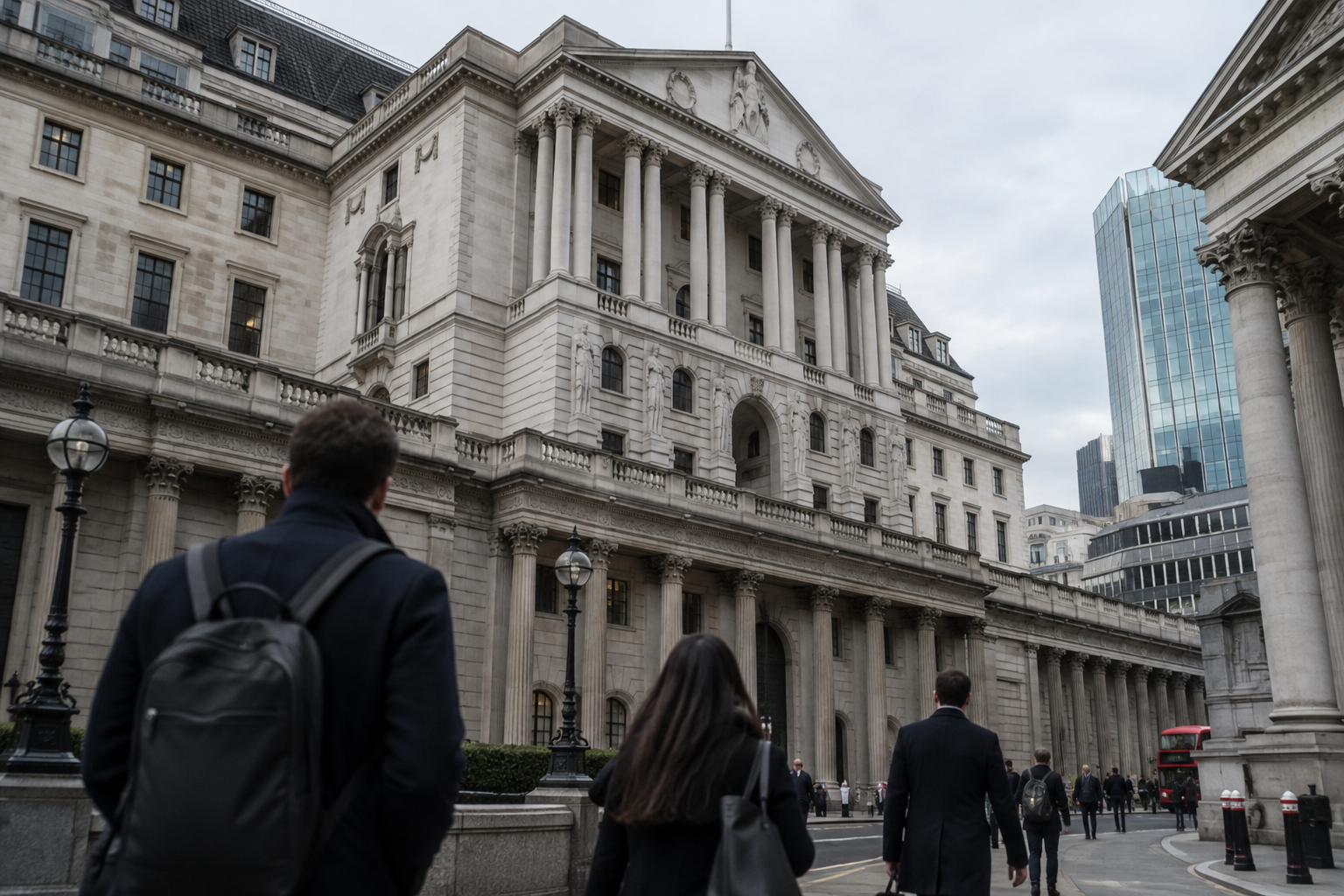
The Bank of England should raise UK interest rates from 4% to 5% to prevent inflation remaining above target until 2030, according to the National Institute of Economic and Social Research’s autumn report.
The Westminster-based think tank’s warning, reported by City AM, comes after the Bank increased rates last week. Its analysis also identifies a potential £30bn gap against the government’s fiscal rules if ministers increase spending in several areas.
What happened
Niesr argues that the economic effects of the Iran war require a stronger monetary policy response than the Bank has indicated. It expects persistent inflation and elevated borrowing costs, rather than a short-lived price shock that subsides as energy markets settle.
The recommendation follows the Bank’s decision to raise interest rates to 4%. Moving from that level to 5% would represent a further increase of one percentage point, substantially beyond the additional quarter-point rise discussed by governor Andrew Bailey.
Under Niesr’s forecast involving only one further increase, inflation would not return to the Bank’s 2% target until 2030. That would leave price growth above target for considerably longer than the roughly 18-month to two-year period associated with the Bank’s medium-term mandate.
The central concern is that an initial increase in prices could trigger further pressure through wage negotiations. Workers seeking compensation for higher living costs could secure settlements that feed into businesses’ prices, extending inflation beyond the original energy shock.
Timing is important to that assessment. About three quarters of UK workers are expected to agree pay settlements during the first three months of next year, when Niesr expects inflation to be above 4%.
The background
The Bank’s own forecast, published last week, sets out a different path. It expects inflation to reach 4.9% in July next year before falling back to 2% in 2028, two years earlier than the outcome Niesr associates with a limited policy response.
That projection depends on an easing of the disruption caused by the Iran war. The Bank assumed that US president Donald Trump would end the conflict, trade through the Gulf would resume in the near term and international energy prices would decline.
Oil prices had fallen by Tuesday after Trump indicated that the war had effectively ended. The Bank’s assumptions nevertheless require a sustained improvement in energy costs through to 2028, rather than simply an immediate market reaction to political statements.
Niesr’s concern extends beyond the direct cost of fuel. It argues that expectations of continuing price rises could become embedded because the economy does not have enough spare capacity to restrain them.
Labour-market conditions are central to that judgement. Higher unemployment or fewer vacancies can reduce employees’ bargaining power, making it harder to secure pay increases that compensate fully for inflation.
The Bank’s Monetary Policy Committee has previously identified that mechanism as a potential restraint on wage pressure. The disagreement is therefore partly about how much the labour market will dampen inflation, not just how quickly energy prices retreat.
What people are saying
Bailey has indicated that a further increase to 4.25% could be justified if energy costs remain elevated and evidence emerges of a larger inflation spike over the coming months. His position makes additional tightening conditional on how those risks develop.
Niesr’s analysts take a firmer view. They argue that the rate-setting committee has responded too slowly and that two increases in total would still be insufficient to bring inflation back to target within the required period.
The institute acknowledges that stronger action would carry an economic cost. In a scenario where rates reach 4.75%, it estimates that GDP growth would be reduced by about 0.4 percentage points in both 2028 and 2029.
That scenario would leave the economy growing by only 0.5% in 2028. It is a separate modelling assumption from the institute’s recommendation for rates to reach 5%, rather than a forecast of the precise consequences of its preferred policy.
Despite the near-term damage, the researchers favour prompt tightening. Their argument is that allowing uncertainty over inflation to persist would create a larger threat to growth later, making delay more costly than early action.
The institute also warns that higher rates would increase the government’s debt interest burden. That would complicate Chancellor John Healey’s efforts to meet fiscal commitments at the same time as ministers face pressure to increase public spending.
What happens next
Upcoming wage agreements and the course of energy prices are central to the competing forecasts. The concentration of pay settlements early next year gives particular importance to the inflation rate workers and employers face during those negotiations.
For the public finances, Niesr identifies the 2027 Spending Review as the decisive point. It says the Budget postponed major choices rather than establishing a stronger fiscal position, leaving those decisions to be resolved in the departmental spending settlement.
Its estimate of a possible £30bn breach of the fiscal rules is conditional. The risk arises if Healey adds to defence and care budgets while also allowing spending in other departments to increase after inflation.
Niesr urges the chancellor to maintain fiscal tightening over the coming years. It also notes that recent governments have increased budgets ahead of spending reviews, a pattern about which the Office for Budget Responsibility has separately warned.
The institute’s challenge extends to both the Labour government and opposition parties. It calls for more realistic positions on spending reductions and tax increases, rather than commitments centred on expanding the state or lowering taxes for households and businesses.
Timeline
2027
Niesr identifies the Spending Review as the key test of government spending decisions.
2028
The Bank forecasts inflation returning to 2%; Niesr’s 4.75% rate scenario puts GDP growth at 0.5%.
2029
Niesr’s 4.75% rate scenario projects a further 0.4-percentage-point reduction in GDP growth.
2030
Niesr expects inflation to reach target only this year if there is just one further rate increase.
Why this matters
For UK business owners and directors, the report highlights the risk of persistent wage pressure alongside higher borrowing costs. The concentration of pay settlements early next year makes inflation expectations particularly relevant to staffing budgets. Niesr’s growth forecasts also show the potential cost of tighter policy to economic activity, while its £30bn fiscal warning leaves businesses facing uncertainty over the spending and tax decisions needed to meet the government’s rules.
Frequently asked questions
- Why is the Bank of England being urged to raise interest rates to 5%?
- Niesr warns that inflation linked to the Iran war could persist through wage settlements and price expectations. It argues that stronger rate increases are needed to return inflation to the Bank’s 2% target.
- Has the Bank of England raised interest rates to 5%?
- No. The report says the Bank raised rates to 4% last week. A move to 5% is Niesr’s recommendation, not an announced Bank decision.
- When will UK inflation return to 2%?
- The forecasts differ. The Bank expects inflation to return to 2% in 2028. Niesr warns that, with only one further rate increase, the target would not be reached until 2030.
- What has Andrew Bailey said about another rate rise?
- Andrew Bailey has indicated that an increase to 4.25% could be justified if energy prices remain high and evidence points to a larger inflation spike.
- How would higher interest rates affect UK economic growth?
- Niesr estimates that rates reaching 4.75% would reduce GDP growth by about 0.4 percentage points in both 2028 and 2029. That scenario would leave growth at 0.5% in 2028.
- Why do pay settlements matter for inflation?
- Niesr expects about three quarters of UK workers to agree pay settlements early next year, with inflation above 4%. Higher wage demands could feed into business prices and prolong inflation.
- What is Niesr’s £30bn public spending warning?
- Niesr says John Healey could miss his fiscal rules by up to £30bn if defence and care spending rises while other departmental budgets also grow in real terms. Higher rates would add pressure through debt interest costs.
In this story
Follow-up coverage
Topics: Bank of England interest rates · UK interest rates 5% · Niesr inflation forecast · UK inflation 2030 · Andrew Bailey rate rise · 2027 Spending Review · UK GDP growth forecast · All Interest Rates news →
Original reporting: City AM. This article is an independent write-up by British Business Echo.
Latest from the newsdesk
- E-commerce
Meta launches Muse shopping agent with major UK retailers
- Funding & Business Finance
British Business Bank takes £43m Oxford Science Enterprises stake
- Business Mistakes / Lessons Learned
Next business data accessed in supplier cyberattack
- Business Growth
UK pork producers secure Vietnam access and Philippines deal
- Business Regulation
HSE tools help small firms check health and safety duties
Related stories

UK inflation reaches 3.6% as Bank weighs another rate rise
October inflation reaches a one-year high, leaving the Bank of England to weigh energy pressures against a soft jobs market.
Bank of England raises rates to 4% as inflation risks grow
All rate-setters backed tighter policy as the Bank forecast inflation of 4.9% next year and warned that another increase could follow.
UK inflation rises to 3.5% as November rate rise looms
September inflation exceeded forecasts as diesel prices climbed, adding pressure ahead of the Budget and November’s interest rate decision.

Andrew Bailey warns energy costs are squeezing business margins
The Bank of England governor says firms are absorbing higher energy costs, but warns their ability to protect customers from price rises is weakening.