Regional Business – North West
JLR adds hybrid option to electric Defender Sport plans
The smaller Defender will use JLR’s EMA platform as the group broadens powertrain choice and prepares to expand the brand beyond its current range.

By Tom Ashworth, North West Correspondent ·
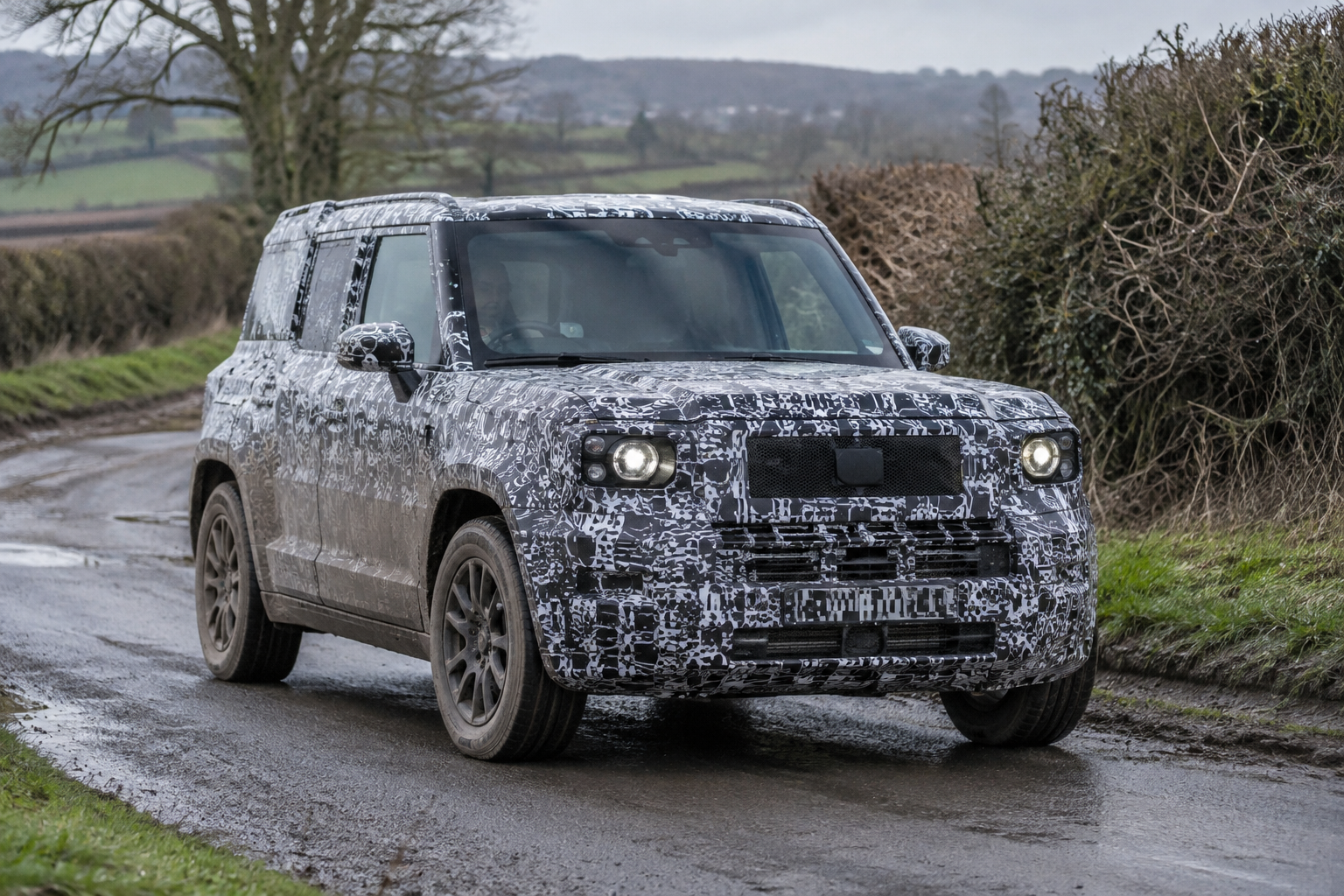
JLR is preparing a smaller Defender with hybrid and battery-electric power, extending the brand beyond its existing model range with a vehicle already undergoing testing on UK roads. The company has confirmed that its EMA platform will accommodate both types of powertrain.
Autocar reports a 2027 launch, although Mark Cameron, managing director for Defender and Discovery, has not given a launch timetable or confirmed the widely reported Defender Sport name. Pricing has not been disclosed.
What happened
The change to EMA broadens the options for an architecture developed with electric vehicles as its starting point. JLR says it will now support hybrids as well as battery-electric models, giving the forthcoming Defender a wider powertrain offering than an electric-only launch would provide.
The smaller vehicle will be a separate product, rather than a battery-powered counterpart to the current Defender 90. Its design reflects the requirements of the new platform, including the space needed to accommodate batteries beneath the floor.
Expected to measure just over 4.5 metres long, it will retain four-wheel drive. That points towards a two-motor arrangement for the electric version, although the precise motor configuration has not been confirmed.
Cameron has acknowledged that the platform and vehicle dimensions are likely to restrict suspension movement compared with the existing Defender. The smaller model is therefore not expected to match the current range’s off-road performance, but substantial capability remains part of its brief.
The development programme also has to reconcile efficiency with familiar Defender design features. An upright body, steeply angled windows and a squared-off rear create challenges when seeking greater battery range or lower fuel consumption.
Electric range is already a prominent selling point in other manufacturers’ launches, including BMW’s £54,925 i3 with a claimed range of up to 566 miles. JLR has not disclosed a comparable range figure for the smaller Defender.
The background
The new vehicle will be the first entirely new product introduced since Defender became a brand under JLR’s restructuring of its model families. Range Rover and Discovery also became distinct brands through that approach.
Cameron said the three years following the announcement of the strategy had been spent developing products and defining the characteristics that future Defenders must share. The present range comprises the 90, 110 and 130 body styles, alongside the high-performance Octa and commercial Hardtop.
EMA will support other future JLR electric vehicles, including the Range Rover Evoque and Velar. The group’s larger Range Rover and Defender products will use MLA, while Jaguar has developed a separate electric architecture called JEA.
The existing Defender already offers a plug-in hybrid, combining a four-cylinder engine with an electric system. Its electric-only range is limited by the D7 platform, which was not originally developed around that technology.
Demand also differs substantially between the brand’s markets. Diesel accounts for most Defender sales in the UK, while the US has become its largest market and electrification is currently a lower priority there.
The addition of hybrid capability to EMA comes against that uneven adoption of electric vehicles. UK policy continues to support charging provision alongside conventional motoring, with a £100m EV charging pledge accompanying an extension of the fuel duty freeze.
What people are saying
Cameron described development of the smaller Defender as “well advanced”. He said the priority was to preserve the attributes that distinguish the brand, rather than allow an electric powertrain to turn the vehicle into a less distinctive SUV.
His planning horizon extends seven to 10 years, with the aim of building a broader luxury lifestyle business from what is currently one model with several variants. He sees durability and the ability to operate across difficult terrain as requirements for every addition.
That approach also governs testing. Cameron said Defender requires at least two winter testing cycles and two hot-weather cycles, even as Chinese manufacturers’ faster development programmes put pressure on established carmakers to shorten their own schedules.
JLR is looking for ways to reduce development time without weakening quality or longevity. The distinction matters for a brand whose intended use places demands on vehicles beyond ordinary road driving.
Cameron also set out a choice between buying components from partners and developing them internally. Battery packs and electric drive units have become more standardised, but their suitability for Defender depends on how they deliver torque and control away from paved roads.
Buying those systems could accelerate a launch, he said, without necessarily producing the right result for the brand. The decision is therefore about which capabilities JLR needs to retain, as well as how quickly it can bring a vehicle to market.
Specialist vehicle businesses face their own choices over electrification, illustrated by Whitby Morrison’s launch of a £200,000 electric ice cream van. For Defender, Cameron identified off-road drivability as a specific test of whether an externally sourced system is suitable.
On customer demand, Cameron said the business intended to maintain a wide choice of powertrains for as long as possible. Petrol and diesel, supported by hybrid technology where appropriate, remain part of that approach while the company can continue selling them.
What happens next
Future architectures are expected to give Defender more scope to develop hybrid technology than the current D7 platform allows. Cameron indicated that subsequent vehicle generations would be needed to extend those capabilities, without setting out technical specifications.
Beyond the smaller model, he has not confirmed individual additions to the range. The US market offers vehicle categories that he considers suitable for Defender, raising the possibility of a pick-up, but no such programme has been announced.
Europe presents a different opportunity because of demand for smaller vehicles suited to narrow streets. Cameron said the brand could accommodate different dimensions provided each product retained the characteristics required of a Defender.
The selection of those products will be driven by profitability rather than a bid to cover every market segment. Cameron said JLR would look for gaps where Defender could establish a credible position, rather than imitate competitors solely to increase sales volumes.
Why this matters
JLR’s decision to add hybrids to EMA shows how differing customer demand is shaping vehicle investment. For UK automotive suppliers, the programme raises questions about which battery and drive systems JLR will buy and which capabilities it will retain internally. For directors planning product development, Defender provides a specific example of balancing speed to market with testing requirements, while prioritising margins over sales volume as a brand enters new segments.
Frequently asked questions
- Will the Defender Sport be electric or hybrid?
- The forthcoming smaller Defender will offer battery-electric and hybrid power. JLR has confirmed that its EMA platform will support both, but has not detailed the hybrid system.
- When will the Defender Sport launch?
- A 2027 launch has been reported, but Defender and Discovery managing director Mark Cameron has not provided a timetable. He has described development as well advanced.
- Has JLR confirmed the Defender Sport name?
- No. Defender Sport is the widely reported name for the smaller model, but JLR has not confirmed it.
- How big will the Defender Sport be?
- The smaller Defender is expected to measure just over 4.5 metres long. It is a separate product, not an electric version of the existing Defender 90.
- Will the Defender Sport have four-wheel drive?
- The new model will retain four-wheel drive. That suggests two motors for the battery-electric version, although the configuration has not been confirmed.
- Will JLR keep selling petrol and diesel Defenders?
- Cameron says the strategy is to retain powertrain choice for as long as possible, including petrol and diesel with hybridisation and other transitional technologies.
- Is a Defender pick-up confirmed?
- No. Cameron has identified opportunities in vehicle categories popular in the US, but has not confirmed a pick-up or other specific models beyond the smaller Defender.
In this story
Topics: Defender Sport · JLR Defender Sport hybrid · electric Defender launch · Defender Sport 2027 · JLR EMA platform · Defender Sport four-wheel drive · All Regional Business – North West news →
Original reporting: Autocar. This article is an independent write-up by British Business Echo.
Latest from the newsdesk
- E-commerce
Meta launches Muse shopping agent with major UK retailers
- Funding & Business Finance
British Business Bank takes £43m Oxford Science Enterprises stake
- Business Mistakes / Lessons Learned
Next business data accessed in supplier cyberattack
- Business Growth
UK pork producers secure Vietnam access and Philippines deal
- Business Regulation
HSE tools help small firms check health and safety duties
Related stories

Wirral’s Borough Yard costs rise £21m as Sisk contract agreed
Wirral Council has agreed a £36.5m enabling works contract in principle, while changes to funding leave an £8.9m programme shortfall.
Lancashire approves £643m transport plan with rail funding
The four-year programme includes £28.2m for Cottam Parkway, station upgrades and bus investment, with major rail reopenings left for further development.

SCALE Manchester names four founders for £13,000 support pitch
Four health and workplace businesses will pitch at Freight Island on 25 November for a support package worth almost £13,000.
Trafford approves £130m Carrington Relief Road by one vote
Trafford councillors back the 2.7-mile road by seven votes to six, with construction expected to start in 2030.