SME / Owner-Managed Business
Whitby Morrison launches £200,000 electric ice cream van
The Crewe family manufacturer has secured early orders for its electric conversion, with a claimed 180-mile range and lower overnight charging costs.

By Eleanor Whitcombe, Editor ·
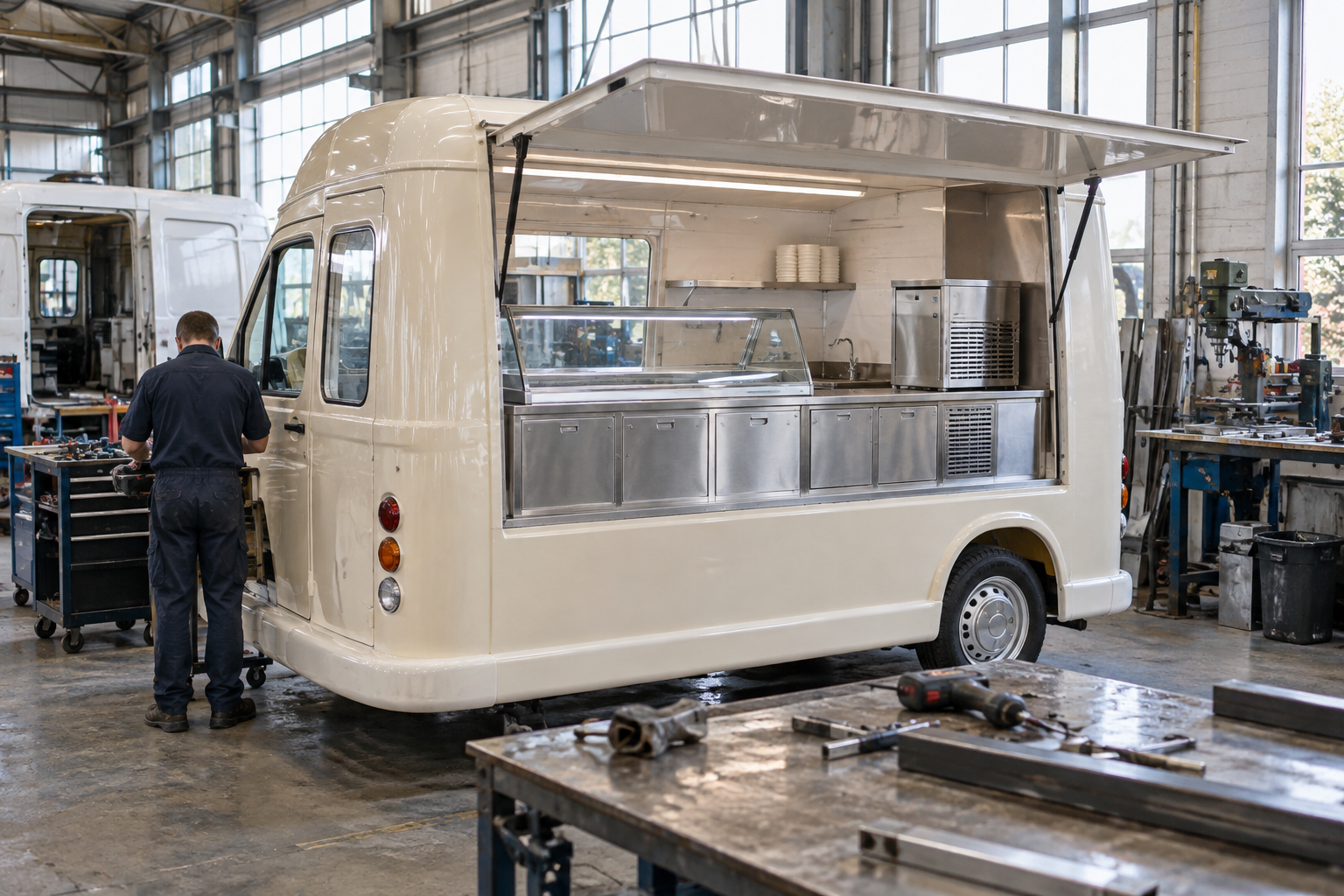
Whitby Morrison has launched its first fully certified electric ice cream van from its Crewe factory, priced at £200,000 excluding VAT, with early customers including Devon operator Hocking’s Dairy Cream Ices.
The family-owned manufacturer has received a handful of orders for the vehicle, which uses a Mercedes-Benz eSprinter chassis cab. As reported by Autocar, the launch extends the company’s move into battery-powered equipment while retaining the specialist manufacturing work carried out by its approximately 50 staff.
What happened
The new eMondial Lusso is built on the eSprinter 414 chassis cab with an 81kWh drive battery. Operations director Ed Whitby puts its real-world driving range at 180 miles, although testing has produced a figure of 200 miles.
The vehicle has a gross weight of 4,250kg. Whitby says it can be driven on a car licence and has sufficient payload for a busy ice cream operator, addressing two practical considerations for customers weighing up a switch from diesel.
Charging the drive battery from 20% to 80% takes just over two hours using a 22kW charger, according to the company. A 110kW rapid charger reduces that to 26 minutes, giving operators an alternative when an overnight recharge is not enough for their schedule.
The demonstrator at the factory is earmarked for a London customer serving upmarket locations. Its restrained cream finish reflects that intended market rather than the brighter colours traditionally associated with roadside ice cream sales.
Electric conversions require changes on the production floor. The team found that attachments to the eSprinter chassis must be bonded rather than welded, introducing a different assembly requirement alongside the familiar work of fitting out a catering vehicle.
Production director Kris Whitby organised staff training and certification for working with electric drive power. He led that preparation after the company secured the opportunity to order its first two examples of the new chassis cab.
The electric model also carries Whitby Morrison’s ePower system as standard. This supplies the catering equipment separately from the vehicle’s drive battery, using three lithium-ion batteries with a combined capacity of 15kWh.
The manufacturer says that capacity can meet the van’s operating needs, including dispensing 3,000 soft-serve cones. The equipment batteries can be recharged at home, while roof-mounted solar panels provide another source of electricity.
The background
Bryan Whitby founded the business in 1962 after developing a way to run a van’s soft-serve machinery from its vehicle drive system. His grandson Ed now oversees operations, while Ed’s father, Stuart Whitby, is managing director.
The factory completes around 80 new ice cream van conversions annually, predominantly on Mercedes-Benz Sprinter chassis cabs for UK operators. Each build takes about eight weeks, but the average interval between ordering and delivery is 12 months.
Much of the finished vehicle is made in Crewe, including its glassfibre body, refrigerators and freezers. Apprentices work alongside the established workforce, and production remains heavily dependent on skilled manual work despite the use of overhead cranes for lifting.
In the cabinet shop, metal sheets are cut, filed and shaped into insulated refrigeration units. The company has also installed a new paint shop, with an investment described by Whitby as well into six figures.
The electric vehicle project grew out of Stuart Whitby’s experience of owning an electric car. The company began considering a conversion when electric delivery vans started appearing around five years before the factory visit, but initially judged their range and payload inadequate.
The eSprinter offered a more suitable starting point, although it was first available only as a panel van. Access to the chassis-cab version subsequently allowed Whitby Morrison to proceed, with the first completed conversion emerging a few months before the visit.
The wider commercial vehicle sector has also attracted investment. Figures from the Society of Motor Manufacturers and Traders cited in the report show more than £1bn committed to British van, truck and bus manufacturing and supply chains over five years.
The trade body identified more than 30 models and conversions already being built or planned for production. These ranged from lower-emission vehicles to electric and hydrogen products, placing the Crewe conversion within a broader shift in specialist vehicle manufacturing.
What people are saying
Ed Whitby sees the certified electric model as a significant development for the business. He says the design is intended to meet operators’ working requirements while reducing noise and moving the sector towards cleaner operation.
His running-cost comparison depends on where customers charge. He says rapid charging brings the electric van’s cost per mile into line with a diesel Sprinter, whereas overnight home charging reduces it to less than a quarter of the diesel equivalent.
Whitby also reports stronger demand in the UK, partly linked to more people taking domestic holidays. Export business, by contrast, has fallen to around 5% of the company’s activity.
The overseas position differs from earlier years. The business sent 20 vans to Azerbaijan in 2014 and, at the time of the previous factory visit in 2018, reported exporting roughly 10 vehicles annually, with one awaiting shipment to Libya.
Whitby attributes weaker overseas appetite partly to Brexit, saying foreign customers have become less willing to buy British products. His response is to compete through technical development and manufacturing quality rather than rely on the company’s established position.
For vendors considering the purchase price, Whitby offers a qualified earnings estimate: an operator with a good trading location could clear £60,000 in six months. That is his assessment of the opportunity, not a guaranteed return for buyers of the new model.
What happens next
Whitby expects vehicle replacement decisions to bring further electric orders as operators assess running costs and potential reductions in objections from councils and event organisers. The company’s early sales do not yet establish how widely the new conversion will be adopted.
Customers retaining diesel propulsion can already specify ePower, which allows serving equipment to run with the engine switched off. The system is installed in 70% of Whitby Morrison’s new diesel vans, providing an alternative to replacing the whole vehicle with an electric model.
That engine-off capability allows traders to serve in settings where exhaust emissions and noise are a concern, including parks, festivals and theme parks. It also enables indoor trading at exhibitions, extending the range of locations available without requiring a fully electric drivetrain.
Timeline
1962
Bryan Whitby establishes the business after developing vehicle-driven power for soft-serve machinery.
2014
Whitby Morrison sends 20 ice cream vans to Azerbaijan.
2018
The company reports exporting around 10 vans annually at the time of a factory visit.
Why this matters
For owner-managed ice cream businesses, the £200,000 purchase price makes charging arrangements and trading locations central to any investment decision. Whitby Morrison’s claimed savings are greatest with overnight home charging, rather than rapid charging. Its diesel-compatible ePower system offers another route to engine-off trading without buying a fully electric van. For the Crewe manufacturer, the transition also requires workforce training and changes to assembly methods while it serves a stronger domestic market and a smaller export business.
Frequently asked questions
- How much does a Whitby Morrison electric ice cream van cost?
- Whitby Morrison’s electric ice cream van costs £200,000 excluding VAT. The eMondial Lusso uses a Mercedes-Benz eSprinter chassis cab and includes the company’s battery-powered ePower catering system.
- How far can the electric ice cream van travel?
- Operations director Ed Whitby says the van has a real-world range of 180 miles from its 81kWh drive battery. The company has recorded 200 miles during testing.
- How long does the electric ice cream van take to charge?
- The company says charging the drive battery from 20% to 80% takes just over two hours on a 22kW charger, or 26 minutes using a 110kW rapid charger.
- How does Whitby Morrison power the ice cream equipment?
- Its ePower system uses three lithium-ion batteries with a combined capacity of 15kWh. The manufacturer says this can supply the van’s catering needs, including dispensing 3,000 soft-serve cones.
- Are electric ice cream vans cheaper to run than diesel?
- Ed Whitby says overnight home charging brings the electric van’s running cost to less than a quarter of a diesel Sprinter’s. He says rapid charging produces a similar cost per mile to diesel.
- Where are Whitby Morrison ice cream vans made?
- Whitby Morrison manufactures its conversions in Crewe, employing around 50 people, including apprentices. Work includes making glassfibre bodies, refrigerators and freezers.
- How long does it take to get a Whitby Morrison van?
- The company reports an average delivery lead time of 12 months. An individual conversion takes around eight weeks to build, and the factory completes approximately 80 new conversions annually.
In this story
Follow-up coverage
Topics: Whitby Morrison electric ice cream van · electric ice cream van price · eMondial Lusso · electric ice cream van range · Whitby Morrison Crewe · ice cream van ePower system · Mercedes eSprinter ice cream van · All SME / Owner-Managed Business news →
Original reporting: Autocar. This article is an independent write-up by British Business Echo.
Latest from the newsdesk
- E-commerce
Meta launches Muse shopping agent with major UK retailers
- Funding & Business Finance
British Business Bank takes £43m Oxford Science Enterprises stake
- Business Mistakes / Lessons Learned
Next business data accessed in supplier cyberattack
- Business Growth
UK pork producers secure Vietnam access and Philippines deal
- Business Regulation
HSE tools help small firms check health and safety duties
Related stories

MoneySuperMarket: nearly 2m small firms skip Black Friday
The estimated number of small businesses sitting out Black Friday has risen from 1.2 million last year, as owners weigh sales against discounting costs.

Treasury sets out self-employed support as IPSE seeks NI reversal
Mileage, parental pay and carer support changes precede Wednesday’s Budget, but IPSE says contractor demand needs attention.

FSB urges cyber protection as attack costs average £195,000
Small firms face costs beyond restoring IT systems, with backups, staff training and recovery planning central to limiting disruption.

Post Office redress deadlines set as independent reviews announced
Two compensation schemes will close to new claims in 2027, with fresh review routes and an investigation into software used before Horizon.