Economic Changes Affecting SMEs
China warns UK of retaliation over electric car tariffs
Britain faces pressure over access to EU manufacturing benefits as China threatens countermeasures against restrictions on its electric vehicles.

By Eleanor Whitcombe, Editor ·
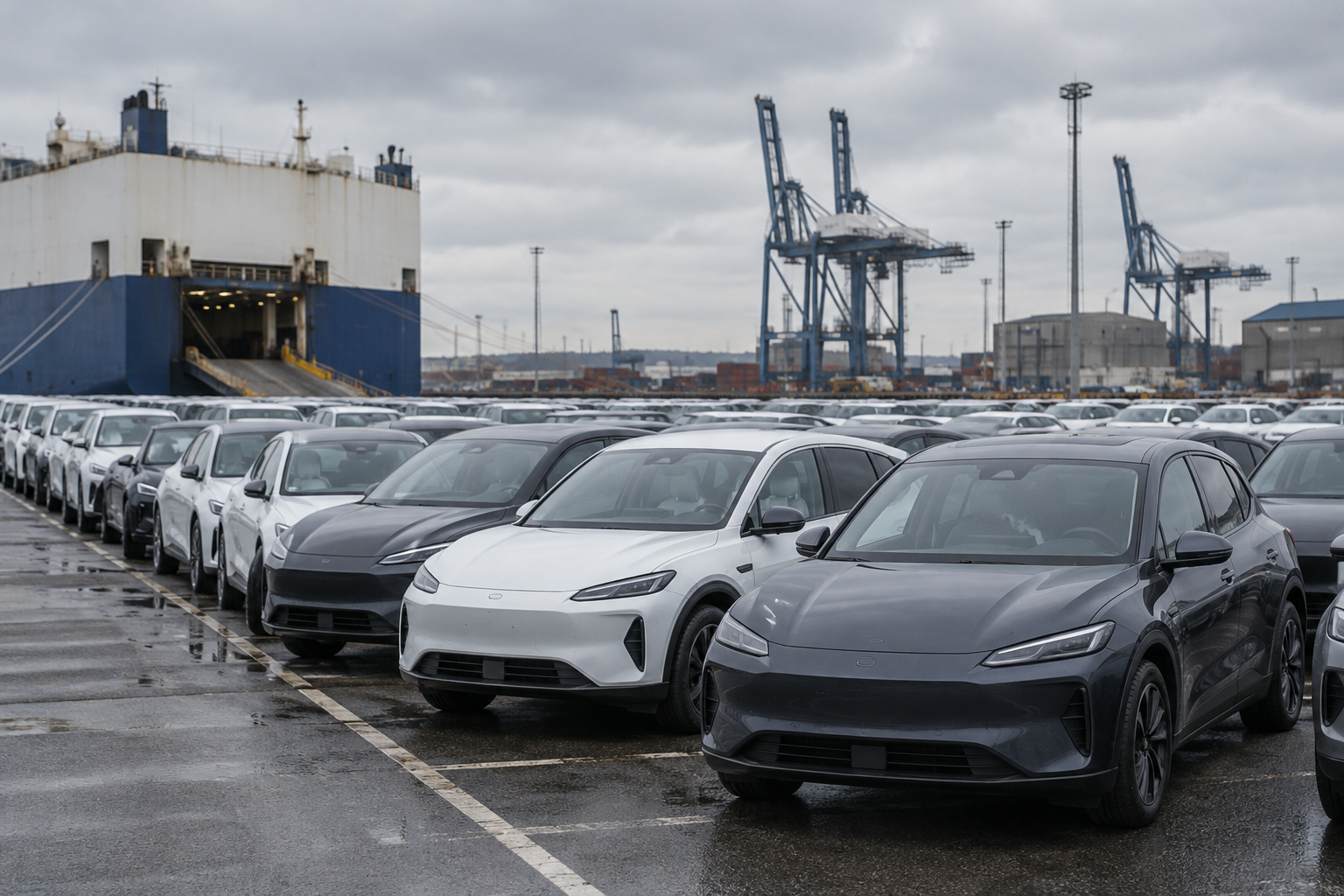
China has threatened retaliation if the UK restricts Chinese electric vehicle imports, as ministers weigh pressure to follow EU tariffs of up to 45% against the interests of British exporters.
The warning, issued by China’s Ministry of Commerce on 19 October, comes as Britain negotiates access to proposed European manufacturing benefits. As reported by Autocar, the EU has reportedly told the UK to introduce tariffs or risk having British-built cars excluded from those benefits.
What happened
Business Secretary Jonathan Reynolds told a government committee on 20 October that ministers were still considering whether to introduce tariffs. He said discussions with European counterparts were continuing, with no decision announced.
The negotiations concern the EU’s proposed Industrial Accelerator Act, which is intended to support local manufacturing against competition from cheaper Chinese imports. Its Made In Europe provisions could affect the treatment of vehicles produced in Britain, making eligibility important to manufacturers with UK factories.
Access could bring benefits covering state incentives for electric vehicles, requirements for electric corporate fleets and public-sector vehicle purchasing. Nissan, JLR, the Society of Motor Manufacturers and Traders and the UK government have all stressed the importance of securing British participation.
China’s commerce ministry urged Britain to respect World Trade Organisation rules before adopting restrictions. Its spokesperson said countermeasures would follow if the UK acted against Chinese electric vehicles, but did not identify what form those measures would take.
The EU’s existing countervailing duties on China-built EVs reach 45%. They were introduced to offset state support that the bloc considers unfair, including direct subsidies, favourable financing and access to raw materials at below-market prices.
The EU has also agreed quotas with China covering hybrid and plug-in cars. Britain would probably be expected to adopt similar arrangements, adding another potential condition to its negotiations over access to the proposed manufacturing programme.
The background
Chinese brands accounted for 23% of the UK car market in September, following rapid expansion by manufacturers including MG, Omoda, Jaecoo and BYD. Their growth has changed the competitive position of established brands in Britain.
SMMT figures placed BYD second among the month’s best-selling brands and MG fourth. The Jaecoo 7 was again the country’s best-selling individual model, illustrating the scale of demand beyond the electric-only vehicles at the centre of the tariff debate.
Sales performance among manufacturers with British production operations has been mixed. Nissan’s UK sales were down 15% for the year to date and Toyota’s fell 1.8%, while Mini recorded a 25% increase and JLR grew 3.6%.
European carmakers had generally resisted tariffs on Chinese vehicles. That opposition has eased in recent months as their sales in China have fallen sharply and competition in their European markets has intensified.
Reynolds told the committee that no UK carmaker had submitted a complaint to the Trade Remedies Authority. Such a complaint is the usual route towards an investigation into whether low-priced imports are being dumped in a market and causing harm.
The authority is already involved in a separate dispute over Chinese industrial imports, having proposed duties of up to 82.89% on Chinese boom lifts. The vehicle debate therefore concerns a different product market in which, according to Reynolds, manufacturers have not initiated that complaint process.
What people are saying
Reynolds said Britain needed to balance conditions in its domestic car market with its position as an outward-facing exporting economy. His comments acknowledged the increase in imports without committing the government to the EU’s approach.
Mercedes-Benz chief executive Ola Källenius warned at the Berlin Global Dialogue that protectionist measures carried a cost. He argued that efforts to strengthen industrial resilience could also push prices upwards, presenting policymakers with competing objectives rather than a straightforward benefit.
MG Motor UK commercial director Guy Pigounakis said additional duties on electric vehicles would leave consumers facing higher prices. He questioned what buyers would gain from a tariff aimed specifically at EVs.
Pigounakis also pointed to the UK government’s Electric Car Grant, which offers reductions of up to £3,750 on eligible vehicles made in Europe and elsewhere. Chinese carmakers are already excluded, he said, arguing that another charge would add to protection already afforded to other manufacturers.
Reynolds disputed suggestions, including concerns raised by Nissan, that Chinese manufacturers could use British assembly operations to gain unrestricted access to Europe. He said assembling vehicles from Chinese components would not, by itself, satisfy the origin requirements in the EU-UK Trade and Cooperation Agreement.
BYD and Chery Group, the parent of Jaecoo, did not provide comments for the report. Their absence leaves the ministry’s warning as the stated Chinese position on possible British restrictions, rather than a company-level response from those manufacturers.
What happens next
The immediate question is whether Britain can secure participation in the Industrial Accelerator Act without adopting its own version of the EU’s duties. That remains unresolved while ministers continue discussions with Brussels and review the tariff option.
Rules of origin provide a separate constraint on production decisions. From January, the agreement requires cars traded between Britain and the EU to contain 55% UK- or EU-origin parts. Assembly plants relying on kits imported from China would not meet that threshold.
Nissan is negotiating with Chery over taking part of its under-used Sunderland factory. The talks put a specific British manufacturing site alongside the wider debate about tariffs, quotas and the conditions attached to European market access.
Independent automotive analyst Matthias Schmidt said Chery had expressed an urgent need for a European production location. He suggested the company was waiting to see whether London could reach an agreement with Brussels that would allow it to avoid tariffs and quotas; that assessment was his interpretation, not a timetable confirmed by Chery.
Timeline
September
Chinese brands account for 23% of the UK car market.
19 October
China’s commerce ministry warns of retaliation against UK restrictions on Chinese electric vehicles.
20 October
Jonathan Reynolds tells a government committee that the tariff decision remains under review.
Why this matters
For UK automotive suppliers and fleet buyers, the negotiations concern both market access and vehicle costs. British-built cars could gain access to European incentives and public purchasing, while manufacturers warn that tariffs could raise prices. Nissan’s talks with Chery also connect the trade discussions to potential use of existing production capacity in Sunderland. Directors face an unresolved policy choice alongside origin rules requiring 55% UK- or EU-origin parts from January.
Frequently asked questions
- Why is China threatening retaliation against the UK?
- China says it will introduce countermeasures if Britain restricts Chinese electric vehicle imports. The warning comes as the UK considers tariffs while negotiating access to proposed EU manufacturing benefits.
- Has the UK decided to impose tariffs on Chinese electric cars?
- No decision was announced. Business Secretary Jonathan Reynolds told a committee on 20 October that the tariff option remained under review while discussions with European counterparts continued.
- How high are EU tariffs on Chinese electric cars?
- The EU’s countervailing tariffs on China-built electric vehicles reach 45%. They are intended to offset Chinese state support that the bloc considers unfair.
- What share of UK car sales comes from Chinese brands?
- Chinese brands accounted for 23% of the UK market in September. BYD ranked second among brands, MG fourth, and the Jaecoo 7 was the best-selling model.
- What would the Industrial Accelerator Act mean for UK carmakers?
- Participation could give British-built cars access to benefits involving state EV incentives, electric corporate fleet targets and public purchasing. The UK is negotiating its position under the proposed EU legislation.
- Would Chinese electric car tariffs increase UK prices?
- MG Motor UK commercial director Guy Pigounakis said additional tariffs would increase consumer prices. Mercedes-Benz chief executive Ola Källenius also warned that protectionist measures could raise costs.
- Is Chery taking over Nissan’s Sunderland factory?
- Nissan is negotiating with Chery over part of its under-used Sunderland plant. The report does not identify a completed agreement or a confirmed timetable.
In this story
Topics: Chinese electric car tariffs · UK China car tariffs · China UK trade retaliation · EU Industrial Accelerator Act · Chinese car sales UK · Nissan Chery Sunderland · All Economic Changes Affecting SMEs news →
Original reporting: Autocar. This article is an independent write-up by British Business Echo.
Latest from the newsdesk
- E-commerce
Meta launches Muse shopping agent with major UK retailers
- Funding & Business Finance
British Business Bank takes £43m Oxford Science Enterprises stake
- Business Mistakes / Lessons Learned
Next business data accessed in supplier cyberattack
- Business Growth
UK pork producers secure Vietnam access and Philippines deal
- Business Regulation
HSE tools help small firms check health and safety duties
Related stories

UK retail sales rise 0.7% after government stockpiling push
Emergency food purchases helped lift October sales, but analysts warn the increase may not signal stronger demand before Christmas.

BRC consumer confidence falls as Gen Z finances weaken
Retailers call for lower youth employment costs as November polling shows weaker confidence in the economy and household finances.
UK inflation reaches 3.6% as Bank weighs another rate rise
October inflation reaches a one-year high, leaving the Bank of England to weigh energy pressures against a soft jobs market.

Ikea shelves UK projects as costs threaten further expansion
The furniture retailer could direct investment to lower-tax European markets after shelving British projects amid rising costs.