Business Regulation
Urban Splash companies ordered to pay £46.5m for safety work
Five organisations linked to Urban Splash must contribute to fire safety work at seven Manchester buildings, following a government recovery case.

By Eleanor Whitcombe, Editor ·
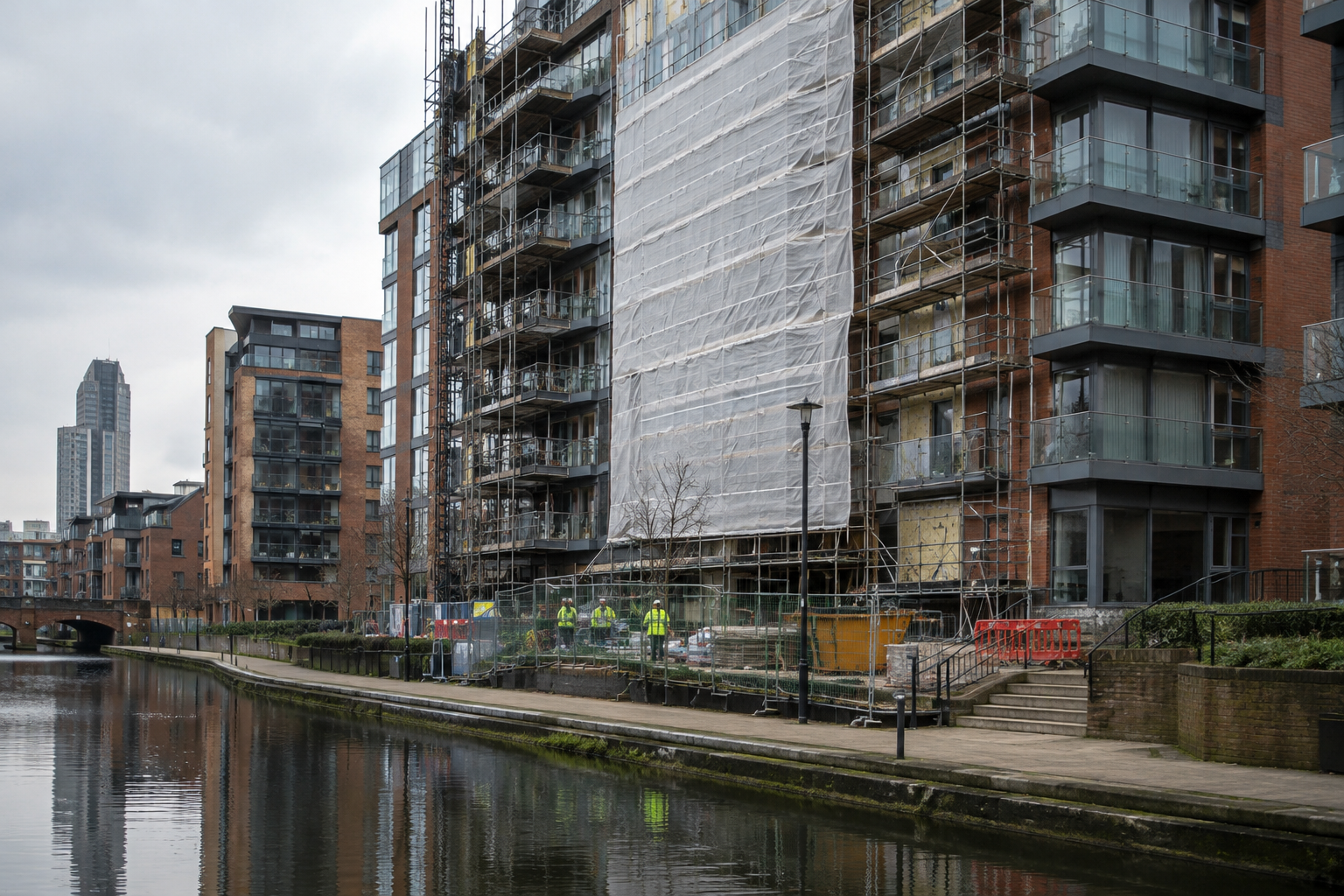
Five organisations linked to Urban Splash have been ordered to pay £46.5m towards fire safety repairs at seven Manchester residential buildings, after the government sought to recover money spent through the Building Safety Fund.
The decision covers most of the £60.6m remediation bill, including VAT, as reported by Place North West. It extends liability beyond the original developer to other organisations connected with the business, including one established after the buildings were completed.
What happened
The organisations required to contribute are Urban Splash, Urban Splash Developments, Urban Splash Group Holdings, Urban Splash Work and Stubbs Mill LLP. The government successfully argued that each should bear responsibility for part of the publicly funded work.
Inspectors identified substantial fire safety defects across the buildings. These concerned combustible materials, cavity barriers, fire-stopping and compartmentation — the measures intended to contain fire and restrict its spread through a building.
The government arranged the remediation using the Building Safety Fund. Although it put the total cost at £60.6m, it sought a lower contribution of £46.5m to reflect its own part in the building safety issues.
Most of the award is due to the Ministry of Housing, Communities and Local Government. The management company responsible for the Moho Building will receive £741,600 to cover costs it incurred in making that complex compliant.
The properties include Burton Place in Castlefield, the Chips Building at 1 New Islington, the Moho Building on Ellesmere Street and The Box Works at 4 Worsley Street. Christabel House, Emmeline House and Sylvia House, all on Dalton Street, complete the seven-building group.
Urban Splash challenged its ability to meet the claim on financial grounds. It also argued that the remediation would have been cheaper had it managed the work itself, rather than the government undertaking it.
The decision nevertheless found a sufficient basis to require contributions from all five organisations. The reasons differed between the original developer, its corporate successors and associates, and the partnership subsequently brought into the group.
The background
The seven buildings were developed about two decades ago, and several subsequently received awards. Remediation at the Chips Building took place in 2023, following the discovery of the safety shortcomings.
Urban Splash was the developer behind all seven schemes. A restructuring in 2013 changed the organisation of the business, with Urban Splash Developments becoming the principal vehicle for development activity.
Urban Splash Group Holdings is the parent company. The decision found that retaining the original Urban Splash company had an economic purpose because its accumulated tax losses remained valuable to the wider business.
Urban Splash Work owns and manages property. Its inclusion rested on its longstanding connections with the wider Urban Splash business, including directors shared with other parts of the organisation, rather than simply its property management function.
Stubbs Mill LLP had a different history. It was formed after the seven residential developments were completed and focused on converting a mill dating from the 1880s into 25,000 sq ft of commercial accommodation.
The partnership was led by the same five business leaders associated with the wider group. The decision found that its structure enabled them to obtain tax relief unavailable to Urban Splash itself and to put personal capital into an investment outside the main company. Urban Splash later acquired Stubbs Mill.
Those relationships were central to the finding that Stubbs Mill should contribute despite not having developed the seven buildings. The case examined the connections and economic benefits across the organisations, not just which entity had delivered each original scheme.
What people are saying
Urban Splash expressed disappointment that the claim had reached organisations without a direct role in the original developments. Its spokesperson said the Building Safety Act allowed liability to spread to associated companies even where they had not been involved in constructing the buildings concerned.
The company also said the size of the award was substantial relative to its business. It maintained that resident and leaseholder safety remained a priority, while warning that the legislation created challenges for businesses involved in housing delivery and regeneration.
Martin McKeague, the government's lawyer and a real estate litigation partner at Walker Morris, said the result advanced efforts to recover public spending on remediation. His assessment was that the decision showed how responsibility could reach the wider enterprise where requiring a contribution was fair.
The tribunal took a more specific approach to the government's criticism of Urban Splash's conduct. It rejected the usefulness of judging the company against an undefined moral obligation, instead considering whether its actions affected the fairness of requiring payment.
It acknowledged that Urban Splash had helped responsibly with investigations into the buildings after Grenfell. However, it distinguished that co-operation from agreeing to fund the repairs which followed; the original developer had not accepted that financial responsibility.
The decision also addressed the original Urban Splash company's current insolvency and the apparent difficulty of securing contributions from others involved in the developments. It concluded that neither outweighed the case for placing the remediation cost on the developer rather than taxpayers.
What happens next
Urban Splash said it was seeking to put a plan into effect with the government and other stakeholders following the tribunal's decision. Its stated priorities are protecting stakeholder interests, preserving jobs and retaining the expertise needed to deliver its regeneration pipeline.
The company said government bodies had continued to support and fund a number of its development and regeneration schemes during the proceedings. It pointed to that ongoing relationship as it sought a way to manage the liability alongside future projects.
The capacity it wants to preserve has produced more than 5,000 homes and 2m sq ft of workspace over a 30-year history. Its proposed work with stakeholders is intended to keep housing and regeneration projects moving while it addresses the financial consequences of the award.
Why this matters
The decision shows that building safety liabilities can reach associated businesses which did not carry out the original development. For property company directors, the findings make shared leadership, corporate history and financial relationships relevant to potential remediation exposure. Urban Splash's response also illustrates the practical pressure of a substantial award: it is seeking to manage the liability while preserving jobs, specialist regeneration expertise and its capacity to deliver future housing projects.
Frequently asked questions
- Why must Urban Splash companies pay £46.5m?
- The government successfully sought contributions towards publicly funded fire safety repairs at seven Manchester buildings. The decision found that the original developer and four associated organisations should help meet the cost.
- Which Urban Splash buildings needed fire safety work?
- The seven Manchester buildings are Burton Place, the Chips Building, Christabel House, Emmeline House, the Moho Building, Sylvia House and The Box Works.
- Which Urban Splash companies have been ordered to pay?
- The five organisations are Urban Splash, Urban Splash Developments, Urban Splash Group Holdings, Urban Splash Work and Stubbs Mill LLP.
- What fire safety defects were found in the buildings?
- Government inspectors found significant defects involving combustible materials, cavity barriers, fire-stopping and compartmentation intended to prevent fire spreading.
- Who will receive the £46.5m payment?
- Most will go to the Ministry of Housing, Communities and Local Government. The Moho Building management company will receive £741,600 for costs it incurred in making the building compliant.
- Why was Stubbs Mill LLP included in the case?
- The decision relied on its shared leadership and financial connections with Urban Splash. Its structure provided tax benefits and enabled personal investment outside the main company. Urban Splash later acquired it.
- What has Urban Splash said about the decision?
- Urban Splash said the liability was significant for its size and criticised its extension to associated organisations. It is seeking a plan with government and stakeholders to preserve jobs, regeneration expertise and future development capacity.
In this story
Topics: Urban Splash building safety · Urban Splash £46.5m ruling · Manchester building remediation · Urban Splash fire safety repairs · Building Safety Act company liability · Chips Building remediation · Stubbs Mill LLP · All Business Regulation news →
Original reporting: Place North West. This article is an independent write-up by British Business Echo.
Latest from the newsdesk
- E-commerce
Meta launches Muse shopping agent with major UK retailers
- Funding & Business Finance
British Business Bank takes £43m Oxford Science Enterprises stake
- Business Mistakes / Lessons Learned
Next business data accessed in supplier cyberattack
- Business Growth
UK pork producers secure Vietnam access and Philippines deal
- SME / Owner-Managed Business
MoneySuperMarket: nearly 2m small firms skip Black Friday
Related stories

HSE tools help small firms check health and safety duties
Risk assessments, staff training and insurance form part of employers’ duties, with a paperwork exemption for firms employing fewer than five people.
TRA proposes higher duties on Chinese excavator imports
Proposed duties of 40.18% to 80.16% would apply to Chinese excavators, with Caterpillar Group exempt from the increase.

B&M sues Morrisons over staff moves and alleged product copying
The discounter alleges eight staff moves helped Morrisons copy seasonal and homeware products. The supermarket rejects the claim.
South Korea steel plate duties set at 7.04% to 23.07%
The UK has imposed anti-dumping duties on South Korean hot-rolled steel plate, limiting the measure to products up to 2,100mm wide.