Business Growth
Sumitomo Electric opens £350m subsea cable factory in Nigg
The UK's first subsea HVDC cable manufacturing plant will create 200 jobs and support connections between Scottish wind farms and electricity users.

By Eleanor Whitcombe, Editor ·
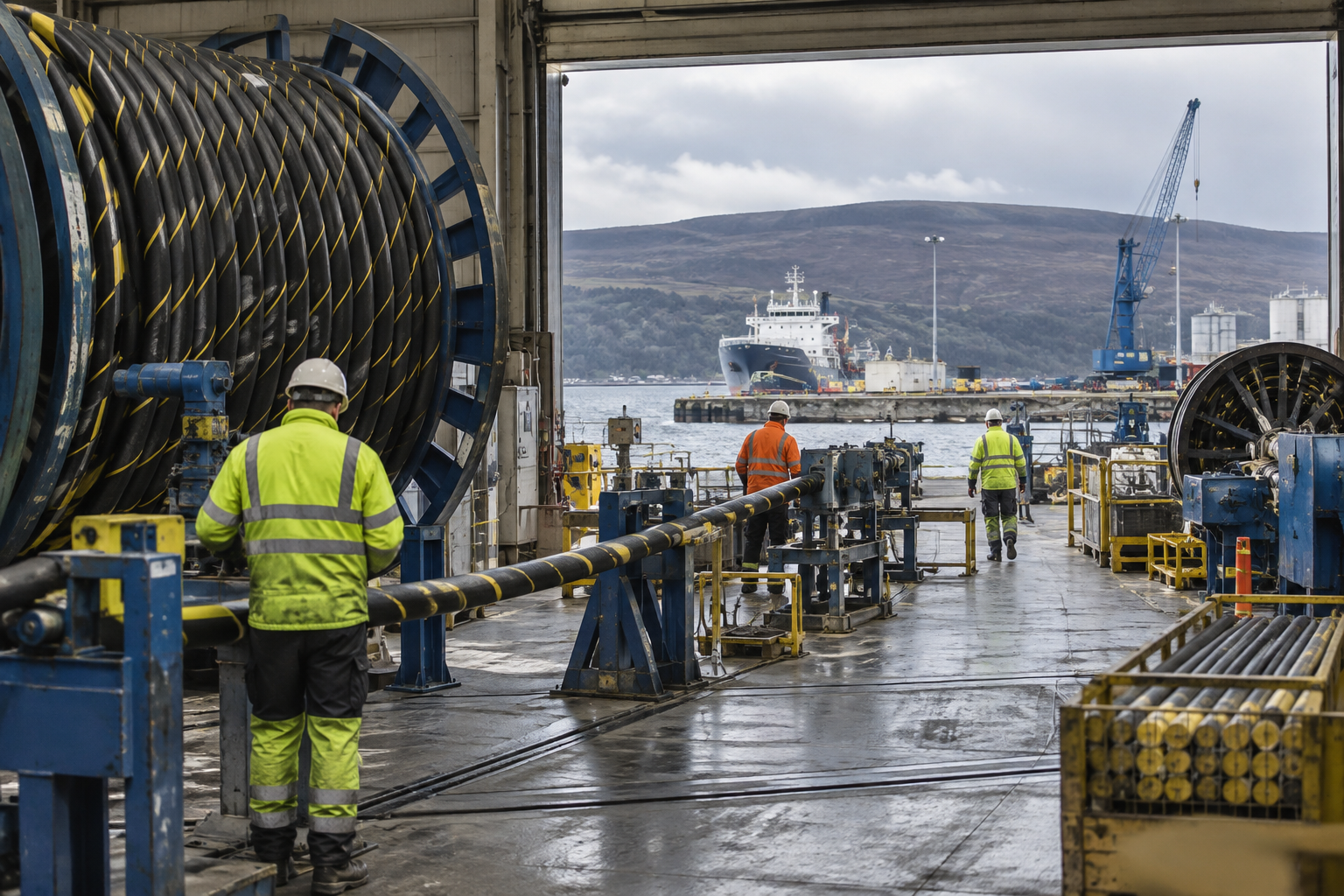
Sumitomo Electric UK has opened a £350m subsea power cable factory at the Port of Nigg in the Scottish Highlands, establishing the UK's first manufacturing plant for subsea high-voltage direct current cables.
Scottish Secretary Douglas Alexander attended the official opening on 19 October. The investment will create 200 jobs and help safeguard hundreds more, according to the announcement published by GOV.UK Business.
What happened
The facility gives the UK a domestic manufacturing base for subsea high-voltage direct current, or HVDC, cables used in electricity transmission. Its opening puts the country among the G7 nations capable of producing their own HVDC cables.
These underwater connections carry large volumes of electricity over long distances. They provide a route for Scottish wind generation to reach areas elsewhere in the UK where electricity demand is higher.
The infrastructure is intended to ease transmission constraints that can force wind farms to stop generating even when conditions are favourable. Addressing those bottlenecks can reduce wasted renewable generation and the costs associated with an electricity network unable to move power where it is needed.
The background
The Port of Nigg, on Scotland's north-east coast, forms part of the Inverness and Cromarty Green Freeport. The freeport has received £25m in UK government seed funding, with the aim of encouraging private-sector development.
That public funding supports the wider freeport rather than representing the announced value of the cable factory investment. The £350m manufacturing project places energy infrastructure production within the port's industrial activity.
Workforce support is also a focus elsewhere in the freeport network, with Solent Freeport launching skills grants of up to £5,000.
The government links the Nigg development to the UK's target of reaching net-zero greenhouse gas emissions by 2050. Its role is in supplying the transmission equipment needed to connect renewable electricity generation with consumers, rather than generating power itself.
What people are saying
Alexander said the decision to manufacture in the Highlands reflected the area's combination of skills, port infrastructure and industrial expertise. He identified the connection between offshore wind generation and electricity demand as a central challenge in the transition to cleaner energy.
He also presented the investment as evidence of the freeport's role in attracting private capital and skilled employment to the region.
Masayoshi Matsumoto, chairman and chief executive of Sumitomo Electric Group, said the factory would support the energy transition in both the UK and Europe. He emphasised the company's cable technology and manufacturing quality standards as the basis for that work.
What happens next
Sumitomo Electric plans to use the Nigg facility to strengthen its relationships with local stakeholders through job creation and workforce development. Matsumoto also committed the business to contributing to sustainability through the new operation.
The announcement does not give a recruitment timetable, annual production capacity or dates for cable deliveries. It also does not identify the individual electricity transmission projects that the factory will supply.
Why this matters
The £350m investment brings a new manufacturing capability to the UK and creates skilled employment in the Highlands. For regional employers and directors, Sumitomo Electric's commitment to workforce development and local relationships is a practical part of the project's significance. More widely, the cables address a constraint on renewable electricity: moving Scottish wind power to customers elsewhere. The announcement does not yet establish production volumes or delivery schedules against which that contribution can be assessed.
Frequently asked questions
- Where is Sumitomo Electric's new UK cable factory?
- The £350m factory is at the Port of Nigg on Scotland's north-east coast. The port forms part of the Inverness and Cromarty Green Freeport.
- How many jobs will the Nigg cable factory create?
- The investment will create 200 jobs and help safeguard hundreds more. The announcement does not provide a recruitment timetable.
- What will the Sumitomo Electric Nigg factory manufacture?
- The plant will manufacture subsea high-voltage direct current cables. These carry large volumes of electricity over long distances, including from Scottish wind generation to areas of higher demand elsewhere in the UK.
- When did the Nigg cable factory open?
- The official opening took place on 19 October, with Scottish Secretary Douglas Alexander attending.
- Why are subsea HVDC cables important for UK energy?
- Subsea HVDC cables help move electricity between generation sites and demand centres. Additional transmission connections can ease grid bottlenecks that force wind farms to stop generating, reducing wasted renewable power.
- Did the Nigg cable factory receive £25m in government funding?
- The £25m is UK government seed funding for the wider Inverness and Cromarty Green Freeport. The announcement separately identifies the Sumitomo Electric factory as a £350m investment.
In this story
Topics: Sumitomo Electric Nigg cable factory · Nigg subsea cable factory · Sumitomo Electric £350m investment · HVDC cable manufacturing UK · Nigg cable factory jobs · Inverness and Cromarty Green Freeport · All Business Growth news →
Original reporting: GOV.UK Business. This article is an independent write-up by British Business Echo.
Latest from the newsdesk
- E-commerce
Meta launches Muse shopping agent with major UK retailers
- Funding & Business Finance
British Business Bank takes £43m Oxford Science Enterprises stake
- Business Mistakes / Lessons Learned
Next business data accessed in supplier cyberattack
- Business Regulation
HSE tools help small firms check health and safety duties
- SME / Owner-Managed Business
MoneySuperMarket: nearly 2m small firms skip Black Friday
Related stories

UK pork producers secure Vietnam access and Philippines deal
Vietnam has reopened to UK processed animal protein, while a Philippines agreement protects pork trade against countrywide disease restrictions.

Sunderland Software City takes roles in £5m research projects
Three international projects link the North East to research in immersive retail, virtual opera and sustainable surface engineering.

Northern Trains opens £307m infrastructure tender
Up to 27 suppliers could join a five-year framework covering stations and depots, with a £21.2m lot reserved for SMEs.

Julie Firth urges firms to simplify how customers choose them
Familiarity, clear websites and well-placed reassurance can shape buying decisions before customers compare suppliers, argues Julie Firth.