Automation & Productivity
Connect Fibre reaches 6,600 Derbyshire premises in £35m rollout
The provider has passed the halfway point of its almost £35m government-backed rollout to rural homes and businesses.

By Daniel Okafor, Technology Reporter ·
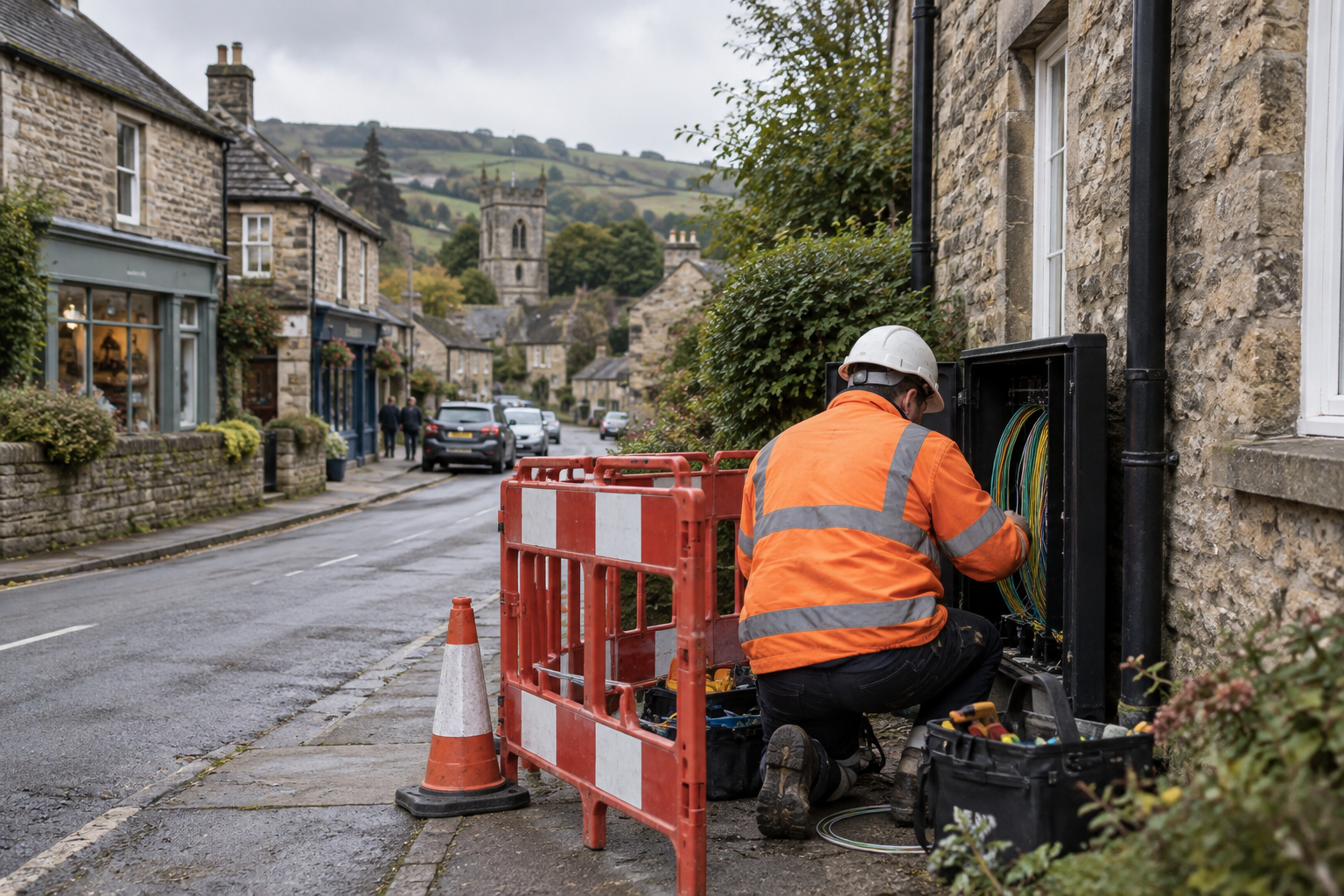
Connect Fibre has made full fibre broadband available to more than 6,600 homes and businesses across rural Derbyshire, passing the halfway point of an almost £35m government-backed contract.
The Project Gigabit rollout covers Bakewell and communities including Alsop en le Dale, Clay Cross, Earl Sterndale, Hulland Ward, Newton Solney and Thulston, alongside smaller surrounding hamlets, as reported by GOV.UK Business.
What happened
The milestone measures premises that can now access the network, rather than the number of households or businesses that have subscribed. The announcement does not provide a take-up figure.
Connect Fibre is delivering the work under Project Gigabit, which funds broadband infrastructure in areas unlikely to be reached through commercial investment alone. Its Derbyshire contract focuses on rural and harder-to-reach locations where connections have been slower and less reliable.
The provider also announced the launch of 5,000 Mbps speeds. The source does not specify prices or say whether that service is available at every premises covered by the contract.
The background
The government positions the programme as a way to support economic activity outside better-connected areas. For independent businesses, including shops in Bakewell, it identifies online customer reach and card payments as practical uses of improved broadband.
For households, the stated benefits include working and studying from home, accessing essential services and keeping in touch with family and friends. The wider policy aim is to allow people to develop careers and businesses without having to move away from their communities.
To illustrate the capacity of a gigabit connection, the announcement compares the time needed to download 47 high-definition films with the time spent baking a local dessert. Its supporting calculation uses a 35-minute Bakewell tart recipe, although the main announcement refers to Bakewell pudding.
The calculation assumes a nominal connection speed of 1,000 Mbps, reduced to an average of about 900 Mbps after network overheads. That would transfer roughly 236 GB in 35 minutes, equivalent to around 47 two-hour films at 5 GB each. The government describes the figures as approximate and illustrative, rather than a performance guarantee.
What people are saying
Connect Fibre thanked the government for supporting the rural build and residents for their patience during construction. The company also said its Project Gigabit work supports local jobs and digital initiatives, although the announcement gives no employment totals or details of individual schemes.
The government said public investment was intended to prevent harder-to-reach communities being excluded as more business activity and everyday services move online. It presented the rollout as infrastructure that could help local firms expand and create employment, rather than reporting measured business growth from the connections installed so far.
What happens next
Construction will continue across Derbyshire towards a stated target of more than 12,800 rural and harder-to-reach locations. The announcement does not give a completion date or identify which villages will receive connections next.
Why this matters
For rural Derbyshire business owners, access to full fibre could make online sales, card payments and home working more practical without relocating. Public funding is extending infrastructure into places the commercial market is unlikely to reach alone. However, network availability is not the same as an active connection: the announcement gives no subscription figures, prices or completion date, leaving firms to establish service availability and costs for their own premises.
Frequently asked questions
- How many Derbyshire premises can access the new full fibre network?
- More than 6,600 homes and businesses across rural Derbyshire can now access full fibre broadband through Connect Fibre’s Project Gigabit rollout.
- How much is Connect Fibre’s Derbyshire broadband contract worth?
- Connect Fibre’s government-backed Project Gigabit contract is worth almost £35m. The provider has passed the halfway point of the rollout.
- Which Derbyshire villages are included in the broadband rollout?
- Named locations include Bakewell, Alsop en le Dale, Clay Cross, Earl Sterndale, Hulland Ward, Newton Solney and Thulston. Smaller surrounding hamlets are also covered.
- What is Project Gigabit funding in Derbyshire?
- Project Gigabit is funding full fibre infrastructure for rural and harder-to-reach homes and businesses in areas unlikely to receive it through commercial investment alone.
- What broadband speeds has Connect Fibre announced?
- Connect Fibre has announced the launch of 5,000 Mbps speeds. The announcement does not specify prices or confirm availability at every premises covered by the Derbyshire contract.
- When will the Derbyshire Project Gigabit rollout finish?
- No completion date is given. Connect Fibre says construction will continue across the county following the halfway milestone.
- Have all 6,600 premises signed up for broadband?
- The figure refers to premises that can access the network, not confirmed subscriptions. The announcement does not disclose how many households or businesses have taken a service.
In this story
Topics: Derbyshire full fibre broadband · Connect Fibre Derbyshire · Project Gigabit Derbyshire · Bakewell broadband rollout · rural Derbyshire broadband · Connect Fibre 5000 Mbps · All Automation & Productivity news →
Original reporting: GOV.UK Business. This article is an independent write-up by British Business Echo.
Latest from the newsdesk
- E-commerce
Meta launches Muse shopping agent with major UK retailers
- Funding & Business Finance
British Business Bank takes £43m Oxford Science Enterprises stake
- Business Mistakes / Lessons Learned
Next business data accessed in supplier cyberattack
- Business Growth
UK pork producers secure Vietnam access and Philippines deal
- Business Regulation
HSE tools help small firms check health and safety duties
Related stories

Amanda Sokell: AI time savings need a commercial return
The productivity specialist says businesses need to show how hours released by software will create value, rather than treating time saved as a return.

Microsoft Outlook and Teams outage disrupts 74 countries
British businesses face disruption after a global Microsoft outage leaves email, meetings and AI services affected for more than 14 hours.
JD Sports rolls out RFID stock tracking across 414 stores
The retailer reports 98% on-shelf availability and faster replenishment after introducing stock-tracking technology across the UK and Ireland.
£40m backs eight UK Robotics Adoption Hubs
Eight regional and sector hubs will help businesses assess and deploy robotics, alongside funding for training and national co-ordination.